This blog has moved

This blog is now at http://www.celesteh.com/blog
Showing posts with label commission. Show all posts

Friday, 6 February 2015

What is Noise Music Anyway?

The question I am most frequently asked about my commissions is, 'What is noise music?' An excellent question!

Noise music is incredibly diverse, from the lush drones of Éliane Radigue, to the aggressive edge of Elizabeth Veldon, to the quiet whispers of Maggi Payne, to the subversive raucous of Cosey Fanni Tutti to the glitchy digitalism of Shelly Knotts. There is also, of course, a specific context and history of the genre, starting with Russolo's Futurist manifesto, The Art of Noise, up through early industrial and bands like Throbbing Gristle and then Japanese noise from people like Merzbow. But even though this is important, let's talk about what sonically unifies these many different sounds of noise music, rather than the cultural bit.

Different kinds of music have different elements that are their primary focus. For example, Bach chorales are largely about harmony. Christmas carols are about melody. And a lot of current pop music is primarily about rhythm. Noise music is about timbre. That means the quality, or texture, of the sound. There can, of course, be all of these other elements in noise music, but a noise composer is very often trying to create a collage of sounds that are interesting based on texture.

Unlike other musical elements, there isn't really a specialist vocabulary for timbre. Sounds might be described as 'rough' or 'smooth' or 'glitchy'. Practitioners talk about this roughly the same way as listeners do. While noise music isn't exactly new – the Art of Noises was published in 1913 – it's still very much an area being explored, not fully codified in the way that other musics might be.

In fact, you can make noise music yourself! Although noise has not historically been given much consideration, any new parent can tell you that babies love noise. Humans are attracted to this kind of music from their youngest moments. We all are born with an attraction to these kinds of sounds. So you can experiment yourself at noise making and try recording some sounds that you think are nice. Your might use the microphone on your phone, your camera or your laptop (or a regular mic if you have one). Try dragging your mic along different surfaces, to record the sound of the physical texture. How does your sofa sound vs a wall? How do different kinds of bricks sound? Or try putting your mic next to something that makes interesting quiet sounds.

Pause for a moment and listen to the place you are at. What do you hear? Maybe your laptop fan? A refrigerator? A kettle? A copy machine? Passing cars? If you put the mic very close to the source of these sounds, sometimes the recordings can reveal hidden depth. Maybe your office copy machine has a quiet rhythmic clicking as it copies.

Now that you have all these recordings, you can try to arrange them. Audacity is a free program that might be useful for this. Or maybe you want to listen to them as they are. Play your collages or recordings for a friend. Now you're a noise composer!

If you have a bunch of recordings you like and want to commission me, I can use them as source material. Commissioned music makes a great gift for babies or for Valentines Day! Order yours today!


Saturday, 6 December 2014

Noisy Week

I've posted TWO noise music commissions this week and sent a third to the patron who commissioned me. I'll post it as soon as she gives me a title.

The first one was in honour of the birthday / retirement of Paul Berg from Sonology. One of his former students organised a large number of short commissions, which were compiled together in something they called 'The AC Jukebox', titled for the software that Paul developed. I talked a lot about the piece on my podcast, where you can read the notes of how it was assembled and some reminiscences on having Paul as a teacher.

The next piece I posted was commissioned by Lauren Redhead in honour of her friend, Caroline, who had a birthday. The party was last night and I have not yet heard how it went down as a gift, so here's hoping it was well-received!

This was a digital piece and since it was my first digital piece in this series, I went a bit overboard with the processing. I wrote a SuperCollider script to generate 10 short source sounds and then used other scripts to manipulate the files as if there were images. I set up a lot of batch processing to go through them. I like this processing method a lot, and so will have more to say about my scripts shortly. I'm calling the suite of tools autoglitch!

Lauren told me that Caroline likes harsh noise, so this piece is a lot of glitching with no reverb. It's dry digitalism! I did have to run it through a short SuperCollider script to remove DC bias, which was very helpful to make it speaker safe without changing the perceptual sound. You can give it a listen on my podcast.

Making that piece created a load of weird, glitchy images, which are also nice. The ideas that lead to this piece and this way of working are very much from talking to Antonio Roberts, who had lots of helpful suggestions and who posted his own tutorials on glitch art. His stuff is great.

As for the piece awaiting a title, I don't want to say too much about it yet, but I will say that the commissioner had a bit of a poppy sensibility, so I used some compression and faux plate reverb.

If you've got a friend with an upcoming birthday or want to give something really original for the holidays, consider giving the gift of noise! If you order now, delivery is guaranteed in time for Hanukkah or Christmas!


Do you love noise music? Do you have fashion? Drop me an email if you'd like your image to be in forthcoming posts about noise and fashion

Monday, 1 December 2014

What is a commission?

When you commission me to write a piece, of music, you essentially pay me to write one minute of noise music. After I write it, you get to come up with the title. You are then a patron of the arts, causing new art works to come into being!

Afterwards, you get a copy of the music, which you are free to share with friends (under the terms of a Share Music License). I retain copyright of the work.

This makes a great gift - you can title the work to honour the recipient, or have a dedication attached. Your friend gets a copy of the piece of music and has their name tied to the music. So If you title the piece, say, 'Happy Birthday to Susan Jones', that would be attached to the music as the title, whenever anybody listened to it. (If Susan Jones feels overwhelmed by this, it can be re-titled.)

And I will do my best to try to make sure that people do listen, by posting it to my website and eventually compiling all the commissions into an album and publishing it.

Let's say you decide to do this, how would it work?

The Process

  1. If your delivery date is less than two weeks away, please contact me before ordering. Depending on my schedule, etc, I will probably be able to accommodate you, but it's a good idea to make sure!
  2. You would then order the commission and I would get to work making it. Do you want a physical CD posted to you or not? When you order, check that you've picked the right item in the shop. One comes with a CD. The other doesn't.
  3. Within a few days, I will send you via email a link to a high quality audio file.
  4. After you listen to the file and decide on a tile, you would send me back the title and dedication.
  5. If you ordered a physical CD, I would then post it to you via first or second class post.
  6. If you would like an MP3 with the correct metadata (including title, etc), I can send that to you via email.
  7. I normally would then post the MP3 online to my website. However, if this is a gift, I'm happy to hold off until after you give the person a file or disk. Or post it right away so you can link them to the site. Whichever works best for you!

Who might this make a good gift for?

Do people really like this?

All my customers have been happy so far!

Will it arrive in time for Christmas or Hanukkah?

Yes, if you order soon!


Music commissions make great gifts. Order now for this holiday season!

Saturday, 29 November 2014

How do commissions work?

Let's say your friend has a birthday next week. Would I be able to do something? How does the commissioning process work?

  1. If your delivery date is less than two weeks away, please contact me before ordering. Depending on my schedule, etc, I will probably be able to accommodate you, but it's a good idea to make sure!

  2. You would then order the commission and I would get to work making it. Do you want a physical CD posted to you or not? When you order, check that you've picked the right item in the shop. One comes with a CD. The other doesn't.

  3. Within a few days, I will send you via email a link to a high quality audio file.

  4. After you listen to the file and decide on a tile, you would send me back the title and dedication.

  5. If you ordered a physical CD, I would then post it to you via first or second class post.

  6. If you would like an MP3 with the correct metadata (including title, etc), I can send that to you via email.

  7. I normally would then post the audio online to my website. However, if this is a gift, I'm happy to hold off until after you give the person a file or disk. Or post it right away so you can link them to the site. Whichever works best for you!

Commissions make excellent birthday gifts. In fact, this is the most popular use of commissions! However, they can also be used to mark other dates or events, like the holidays! Although I can usually do last minute commissions for birthdays, with larger holidays, its safer to plan in advance! If you order in November, delivery is guaranteed in time for Hanukkah or Christmas!


Do you love noise music? Do you have fashion? Drop me an email if you'd like your image to be in forthcoming posts about noise and fashion

Wednesday, 19 November 2014

Acoustic Noise

I've just posted a new piece of noise to my podcast, which was commissioned and titled by David Jensenius.

Shorts #31: 1416343620

The title he gave me is the unix timecode (aka: the time expressed as milliseconds since Midnight 1 January 1970 GMT) that he received the commission.

I've always had a particularly hard time coming up with titles. Sometimes, it took me as long to title a piece as it took to write the piece in the first place! When I first started this commissioning project, I was somewhat thinking of Mark Twain.

In one of the Tom Sawyer stories, Tom has been told to paint a fence. Since he doesn't enjoy the task, he starts thinking of ways to get somebody else to do it for him. He could pay them, but he doesn't have much money. He decided to use psychology instead. He would convince other boys that painting was really fun and they would ask to do it. Then, he realises, if it's such a joy, they might pay him for the chance to paint. All those pick-your-own strawberry fields are based on the same principle.

I hate picking titles, so therefore, other people should pay me to do it for me! Of course, there's more to a commission than that! There's the knowledge that you've caused a new work to exist, and a piece of music made just for you!

David wanted an acoustic piece, so I recorded a bunch of sounds around my house. The house is still being painted and the dog was still quarantined, so this combination limited my access to hard drives full of archived recordings (waiting for music to be put into) and made it hard to go out into the world and get new recordings. Fortunately, there's a lot of fascinating little sounds in the home. I've been intending to record my tea kettle for some time, and this finally got me to do it, with my zoom recorder. (Surprisingly, the wider angle microphones got a much nicer recording than the close ones, so keep that in mind, should you decide to record your own kettle.)

I got one extra sound that just did not fit into David's piece. I recorded myself growling into a microphone, which made a nice harsh noise sound, but the rest of this piece was not harsh. Fortunately, I found a good application for that sound: the Swift Noise Compilation.

A few weeks ago, Taylor Swift released 8 seconds of white noise to iTunes, which topped the charts in Canada. In dedication to her chart topping short noise single, a tribute album is being put together of 8 second long noise pieces. This is extremely short, even for me!

The brief said white noise, but I strayed from that. My growl was only about 4 seconds long, so I ran it through PaulStretch and then used sox to cut it to exactly the right length:
sox --norm stretch.wav trimmed.aiff fade 0 00:00:07.98 0.07 pad 0.02@7.98
This trimmed the sound to 7.98 seconds, with a 0.07 second fade out at the end and 0.02 seconds of silence after that. Then, I used Audacity to put a stereo plate reverb filter on it. I love plate reverb and if I lived some place quiet, I'd try to get a real one.

My next acoustic commission will have a wider world to draw from, as my puppy is now finally clear to walk anywhere I'd care to take him. Today he will have his first trip to a dog park!

I've got another commission in my queue and then after that, I'm free to work on yours! Commissions make great gifts. If you order in November, delivery is guaranteed in time for Hanukkah or Christmas!


Do you love noise music? Do you have fashion? Drop me an email if you'd like your image to be in forthcoming posts about noise and fashion

Monday, 17 November 2014

New Noise

I've just posted a new piece of noise to my podcast, which was commissioned and titled by Dan Stowell.

Shorts #30: A lazy afternoon in the shade

The title he gave me is a reference to the Philae comet landing. Dan asked for analogue noise, adding he wanted 'undulations', if possible. I made some sound that seemed fairly undulating to me, which I recorded in five tracks, all somewhat different from each other. They used my new Gravity Well module from Circuit Abbey, which does orbital modelling. Since I was checking for comet news in between recording, this seemed to fit with the feeling of the day. I decided to use the comet mission as a metaphor for how to mix the piece.

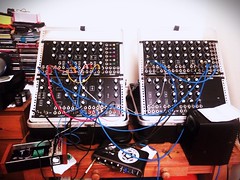
Synth patch for second commission

The first part has a slower undulation and a slowly looping cycle, which I imagined like orbiting the solar system. Then it goes to a much tighter, shorter loop, like orbiting the comet. Then it goes into a nice low rumble, like rocket engines. Finally, it ends with a very low clicky sound, like the comet might be making. Thinking of it in this way really helped me to organise the material, which had more variation than I would normally use for such a short piece.

Comet patch

However, a problem became apparent when I tried to listen on my laptop's internal speakers. The nice low rumbles were too low for my speakers! However, in the meantime, an actual comet sonification was released by the ESA, which is striking for a few reasons, including how beautiful it is and how much it sounds like synthesis! I decided to emulate it, with a pulse wave and white noise going through a resonant bandpass filter, with (alas, digital) reverb added on in the mix. This filled up the top frequencies and also gave it a good cadence at the end. It definitely made it a stronger piece, but I think it overwhelmed the undulating

Normally, in such a short piece, I would have three closely related ideas. This piece, however, has enough ideas for a piece two or three times as long. However, if I were going to do one thing different, it would be to use a different reverb. I've been wishing I had spring reverb for more than 20 years now, so maybe it's time to finally give in.

There are a lot of reasons you might pick to commission a piece of music, like just because you want to be a patron of the arts! Commissions also make great gifts. If you order in November, delivery is guaranteed in time for Hanukkah or Christmas!

Saturday, 15 November 2014

Sounding Good

Last night, I decided to do the final mixdown of the latest piece while sat in my living room, through my internal speakers. I recorded a bunch of sounds that used my low pass filter, because it's really got a very nice, Moog-y sound. What the sounds don't have are high frequencies, because of the filtering. Which means when I went to mix them, there was nothing at all coming out of my speakers.

It happens to be the case that, as laptop speakers go, mine are particularly bad. But, judging from the statistics of people reading this blog, most of you aren't on mac either. When I got this computer, I told myself that the terrible internal speakers didn't matter, because I would never use them and would always plug into better speakers. That's what I told myself, at least. The reality is that I sometimes listen to stuff, even noise and other non-pop music, through the internal speakers. And it's not reasonable to make somebody a commission and then dictate that they have to use special speakers to listen to it. I'm going to have to record a bunch of new stuff, with higher frequencies in it.

This issue of mixing for laptop (or earbuds or internal phone speaker) was first brought up in popular music by Bjork in her 2001 album Vespertine, which was specifically mixed to sound good on a mac laptop. In the 13 years since, all of pop music has followed her. If you've ever wondered why bass lines seem to be missing from most top-40 dance-y singles, this is why. They don't sound good coming out of an internal laptop speaker or internal phone speaker and a lot of ear buds distort them.

Of course, all of pop music is, on some level a response to technology. singles are the length that they are partly because of the durations of wax cylinders - the first recording medium. But as a bass player, a tuba player and a composer, I have some nostalgic feelings for low notes. I think the answer to the conundrum is to mix carefully - make sure the piece sounds good coming from just laptop speakers, but leave in the low tones, so when people put it through better equipment, they get a nice surprise.

If you or someone you know wants to make a commission and don't care about laptop speakers, let me know, and I'll subwoof it up! Otherwise, you're getting music engineered to sound good no matter how you play it. Noise music commissions make great gifts for people, whether they're low-fi or high-fi! If you order in November, delivery is guaranteed in time for Hanukkah or Christmas!


Do you love noise music? Do you have fashion? Drop me an email if you'd like your image to be in forthcoming posts about noise and fashion

Wednesday, 12 November 2014

Gluten Free Noise!

All noise music compositions are 100% gluten free and contain no soya based fillers, and are suitable for vegetarians. One listener asks:

My friend is allergic to nuts and to noises made with nuts. For example, he cannot listen to the Nutcracker. Is your music processed in a facility that also processes nuts? Is it possible to commission a noise piece with no trace amounts of nut noises?

Yes, this is possible!

For people with such, ahem, severe nut allergies, any music recorded in or previous to 2006 may contain traces of nut sounds. An audit, undertaken this morning, indicates that all music from 2007 onwards is entirely nut-free. If you have any specific allergies, for example, to nut sounds or equal temperament, please make this clear when placing your order. (Some pieces on my podcast may contain traces of 12 tone equal temperament, but none of the past commissions do.)

Commissioned pieces of music make great gifts for hard-to-shop for people! Delivery is guaranteed in time for Hanukkah or Christmas. Order now! The introductory price of £5 will only last until Thursday.

Do you have any questions of your own? Let me know and I'll answer them in a forthcoming post!


Do you love noise music? Do you have fashion? Drop me an email if you'd like your image to be in forthcoming posts about noise and fashion

Tuesday, 11 November 2014

Sustainability

Someone on Diaspora asked me: if I only use recorded sounds once, how does this effect sustainability of my music?

This is an interesting question! While the sounds themselves are not recycled, this actually does effect my disk space usage. Once a piece is done, its done and I don't need the source sounds any more, so I have no need to keep them around. This means that at the end of creating a minute of noise, I have, usually, an uncompressed file and a compressed Mp3 (plus whatever file format the commissioner wants for themselves). A minute of AIFF or WAV runs up to 11 MB and the MP3 is around 1MB, so this really takes up very little hard drive space. (Indeed, the Mp3 could fit on a floppy disk!!)

There are other concerns in sustainability however, one of the most important is e-waste. Every time you get rid of an old computer, it needs to be disposed of without causing pollution. This makes disposal a challenge. Indeed, getting a new laptop involves a fair amount of pollution and may also include conflict minerals. I'd say upgrading hardware is a greater sustainability issue than hard drive space might be. How does this interact with my music?

  • Digital Music - This has the greatest potential for e-waste, however, my laptop is already 4 years old and I have no plans to upgrade it, because it is fast enough to do what I want. I write my own programs in SuperCollider to digital audio. When I started doing this, more than a decade ago, I had to be smart about efficiency, so I could get everything to run in real time without maxing out my processor. I really have never run into this issue at all with my current laptop - I feel like the upgrade cycle is now more driven by graphics. I run Ubuntu Studio, which also specifically supports older laptops. Should this laptop die, I would probably get a used one. Indeed, I'd look for the very same one I have now.

  • Acoustic - I mentioned using sounds from all kinds of various locations as possibilities in acoustic pieces. However, these were gathered while I was already in the area. I try to avoid flying as much as possible. Since I don't re-use sounds, putting together an acoustic piece frees up space on my hard drive.

  • Analogue - when I bought my synthesiser, 15 years ago, I also bought a computer at the same time. I still use the synthesiser all the time. Analogue hardware doesn't go obsolete and doesn't require upgrading. When I get new modules, it's to add new functionality, not to replace what I've already got. For people who want to make electronic music, analogue gear has a higher upfront cost, but outlasts digital. I expect my synth is less than halfway through it's usable life. Planned obsolescence and the e-waste created by that is just not an issue.

Commissions are ecologically friendly and make great gifts! Digital-download-only commissions are a perfect gift for for Green friends and family who want to avoid clutter. Delivery is guaranteed in time for Hanukkah or Christmas. Order now! The introductory price of £5 will only last until Thursday.


Do you love noise music? Do you have fashion? Drop me an email if you'd like your image to be in forthcoming posts about noise and fashion

Friday, 7 November 2014

Making a Connection

And the most difficult of Etsy's points for marketing my shop:

  • They need a connection. In a screaming sea of marketing messages, they need to see that you’re a kind and interesting human being, and therefore worth listening to.
[Puppy. Click through for album of puppy images]

I've just taken a break from playing with my new puppy to try to deal with this stipulation of sincerity-on-demand. Well, half taken a break. My kitchen, bathroom and living room are all being repainted at the moment, so the house is extremely chaotic and there's stuff everywhere. The 13 week old puppy is very curious about exploring, and very into exploring with his teeth, so I have to see where he's gotten off to and make sure that the chewing I hear is his rope toy and not a power cable. I did catch him tasting the plug for my synthesiser last night. We have 220 volt power in the UK, so should he actually chew through a cable, that would be very bad news.

Last night he also got himself tangled in my patch cords, which is suboptimal and caused my audio interface to tumble, but fortunately, I caught it before it hit the ground. This is extremely poor timing on the painting, since the puppy's vaccinations have not yet taken effect. I can't just go tire him out in the dog park. He can run around the house or the smallish back garden (where he tries desperately to eat every ornamental plant in it). A relatively puppy proof living room with a kong toy is fine, but the bedrooms are less so. He also wants to show off his newly acquired ability to run up and down stairs. Anyway, it's good I'm only trying to write things a minute long, because sometimes it seems like he's interrupting me every 30 seconds, by racing past with my housemate's underwear in his mouth or sneaking down to the rooms that are being painted. (note to self: buy a baby gate). (I could lock him in my room, but then he'd be eating my underwear. And seriously, if this paragraph seems scattered, it's been interrupted 4 times. I know he needs better boundaries etc, but the painting is making it difficult.)

Anyway, back to the point- I'm not sure I agree with the point, actually. Milton Babbitt was well known both for his amazing compositions and his anti-listener screed, 'Who Cares if you Listen'. Even Lou Harrison, a benevolent and Santa Claus like figure who I had the great pleasure of meeting and speaking Esperanto with, could be a wee bit of a jerk sometimes. He only thought music was worth his time if he agreed with the tuning system and was contemptuous of composers who used other systems, telling them that their 5th was two cents out of tune. On a musical level, I don't think it really matters if composers are kind or are good conversationalists.The interestingness of their music matters a great deal.

I don't think music is a special case in this. A few Christmases ago, I got my sister in law a very nice mug off of Etsy that has owls on it. I did it because I like getting something handmade, because it seems more special and because she loves owls. I communicated briefly with the artist and he was polite and prompt, but I just don't know about the rest of this. Maybe other people feel differently? Leave a comment if you have a thought on artist personalities.

Whether or not I'm worth listening to, however, is easy to decide. My past commissions are available for your perusal, so you can make up your own mind on this. I've got two more underway at the moment! The music commissions are all handmade, and one of a kind. They make a very special gift. Order now and delivery is guaranteed in time for Christmas or Hanukkah. Act now to get the sale price of just £5 for one piece - there are only two left at that price point!

Thursday, 6 November 2014

Noise Music for Busy Professionals

Continuing to work through Etsy's guide to holiday marketing, let's look at what else customers (that's you!) need:

  • They need context. They need to know why, among all those other gift ideas threatening to bury them, your product is a good choice for specific people.

In my previous post, I wrote: 'This is noise music for busy professionals, for people who are new to noise or for folks who just like miniatures.'

Consider for a moment that every culture of humans on earth makes art and music. No matter how isolated or remote, everyone's got art and music. Music is a human universal. Indeed, it's part of what makes us human. We all know we need music - that's why mp3 players are so popular. But why noise music in particular? And why miniatures?

Well, what is noise? This gets into some deep philosophical issues! There are some great books on this that I can't hope to summarise here, so let's just say that noise music is made up of sounds not often currently used in music. Noise has sounds, textures and forms that are currently outside of established boundaries of most music - for now. But music is constantly changing and needs new forms, sounds and textures! Today's noise sound is tomorrow's pop sound. Noise music is, in fact, the future of music.

It's not the immediate future. Indeed, noise music offers potential futures. But by listening to noise music, you hear the cusp of music before others. If you're a busy professional, you know that those who get ahead are the ones who anticipate trends before they happen. So much capitalist success is realising what's going to be in demand in advance, so you're able to come up with the supply.

Obviously, for capitalists, there's more to life for work - there's also conspicuous consumption. But it's good to be in practice on keeping ahead of things, inside and outside your fields. Your friends and colleagues will recognise your far-sighted views, when you share a commissioned noise music piece on your social media account - whether on the tried and true CIA-data-gathering of facebook or the trendy and exciting ello, your contacts will know that you've got your eye on the horizon!

Because the piece is short, it gives you a bite-sized glimpse into the future, without unmooring you from the demands of daily life. Yes, you'll be transported, but still have plenty of time to make your train! And, indeed, your associates who are curious about your new work of art, will be willing to give the whole thing a go. Your cultural capital will increase as a result of your far-sightedness and the easily digestible length. What could be conspicuously consumed than a short musical commission!

Is someone in your life is a rampant capitalist, super busy or would just appreciate and extra bit of cultural capital? Short noise pieces make great gifts. Order now and delivery is guaranteed in time for Christmas or Hanukkah. Act now to get the sale price of just £5 for one piece!

How Noise Commissions are Made

I've just read the Etsy Guide for building one's shop, including a section on what customers (that's you!) need:

  • They need a story. They need to hear how your product is made, and what brought you to create it. They need a reason to become attached to you and what you make.

The making of a minute of noise starts with material gathering. For acoustic pieces, some of this may have already happened! When I was sat in the bell tower of San Giorgio Maggiore, Venice, waiting for the hour to strike so I could record the bells ringing in 2011 or just last month in St Augustine's Tower in Hackney. Or, I might go out to acquire sounds, sticking microphones to clothes washing machines, or in refrigerators, or to get the squeal of breaks at Tower Hill Station. Perhaps, even going further afield for your composition, dangling microphones just into the edge of active volcanoes, to get the sound of it melting! I don't re-use sounds, so whatever sounds I've gathered for your piece will only be in your piece.

For analogue sounds, I'll probably start plugging cables into my synthesiser, but might try a zero input mixer going to a chaotic filter bank. No to patches are alike. It's nearly impossible to recapture a patch once it's unplugged, even if I wanted to. For folks after digital sounds, I'll fire up SuperCollider and start creating a timbres and a tuning to go with them - based on a bespoke tuning algorithm. (Which I should really publish a paper about, actually. If you want to try it yourself, its in the TuningLib quark.)

Once I have a base layer of sounds, I'll start manipulating them, either varying their sounds for the minute duration or finding extra sounds to go with them. Obviously a minute is not very long, but well over a hundred discrete events can happen in that time, all of which must be related to each other in order to make musical sense, but different from each other in order for progression. What features will vary over the minute and by how much? What sonic glue needs to hold the thing together?

Usually, for a one minute piece, I'll have three major sonic ideas, all of which will be closely related to each other.

Every piece comes with program notes explaining how it was made, where the ideas came from and how it was assembled. For digital pieces, the source code to create it is also available! You can find examples of past commissions, including recordings and program notes on my podcast.

I started making one minute pieces in 2007, when I was in a bit of a rut and bored by everything. I didn't want to listen to anything for very long. I ordered my iTunes library by duration and only listened to stuff that was less than two minutes long. If I only wanted to listen to such short pieces, it stood to reason I should only write such short pieces. But while working on them, the possibilities of the duration just began to expand. I was spending about 4 hours to write a minute and that time investment was getting longer and longer, as more and more subtlety and opportunities for expressiveness became clear.

I took a break from writing shorts, not because I wanted to, but because my supervisor told me that my PhD could not be all one minute pieces. so, reluctantly, I began working on longer pieces again.

Why have I come back to this short duration? Not just because of the wealth of possibilities, but also because of extreme personal grumpiness. Your music is handmade by a curmudgeon in Hackney.

But why should you want a minute of noise? Because it's the best duration for grumpy people! Even somebody with an attitude that could sour milk will find a minute to enjoy a hand crafted piece of noise. Your friends and associates will all be happy to listen for one minute. A minute is accessible on many occasions! You can spare a minute to listen to something. This is noise music for busy professionals, for people who are new to noise or for folks who just like miniatures. Short noise pieces make great gifts. Order now and delivery is guaranteed in time for Christmas or Hanukkah. Act now to get the sale price of just £5 for one piece!

Tuesday, 4 November 2014

Music comissioning is back!

Folks, I'm offering up to 30 commissions this November of 1 minute long noise music pieces. You as the commissioner get to name the piece. Your role as titler and commissioner will be mentioned in the program notes. If you commission a piece as a gift, or in honour of another person or of an event, the person and/or event will also be mentioned in the program notes. A new piece of music will be created, just for you! Within a week, you will get a copy of the piece emailed to you in the audio format of your choice (MP3, AIFF, WAV, Apple Lossless, AAC) and have one week in which to come up with a title (I reserve the right to nix titles that I deem offensive). I retain copyright, but the piece will be released under a Creative Commons Share Music License, so you (and the honoree) can share the piece with friends via CD or the internet.

As a special feature for this burst of commissions, you can optionally specify if you want your piece to be acoustic, analogue or digital. Also, optionally, let me know if you might use the piece as a ringtone to ensure it gets composed to sound good and loud coming from a mobile phone. All commissions will be delivered in time for Christmas or Hanukkah.

The introductory price for the first 5 is £5. This will go up shortly, so act now to get it. This is for digital delivery only. You are free to burn your piece of music on to CDs and give them away to friends, but if you want a signed CD from me, that's also possible for an extra £3 + postage.

Get it from my Etsy shop!

Why restart this project?

I still need a few more short pieces before I can put out the long-awaited CD of shorts. And also, the last time I did this, I was in a bit of a rut where I hadn't really written anything for a while and it got my composing again, so hopefully, that will also work again now.

Friday, 12 August 2011

Dissertation Draft: Copyright, Social Networking and Commissioning Music

When I started at Birmingham, I was in the midst of a project where in I was soliciting commissions of pieces of music around one minute in length. My plan was originally to compose 45 of these in total and release an album at the end. I intend to pick up where I left off and finish the project after graduating.


This project was an attempt to get a bit of attention and to address some economic and political issues of music distribution. The amount of music available to listeners only continues to rise. Every day, somebody records something and makes it available in a digital format. The cost of providing copies to consumers is practically nil. Any composer can upload an mp3 to last.fm or bandcamp at no cost. (“Bandcamp Pricing”)


Because copying and distribution is so cheap and easy, consumers often share files without paying for them. The Recording Industry Association of America [RIAA] struck back against this by suing fans (“For Students Doing Reports”), an idea which seemed poorly thought out and which has made them extremely unpopular. (Reisinger) At the same time, the duration of copyright keeps being extended, seemingly so that Mickey Mouse will never fall into the public domain. (Springman) What used to be a system to make sure that creators got their fair share is increasingly perceived as a way for big companies to control culture. (Lessig 61) Rather than adapt to new conditions, media companies are lobbying for new laws to force the genie back in the bottle. (Lessig 48) Some of these, like the Digital Economy Act are fairly draconian in that households may have their internet switched off if only one member of the household breaks copyright law. (Digital Economy Act s. 10) Despite the severity of this crackdown, many are skeptical it will make any difference. (“Q&A: The Digital Economy bill”) Rather than adapt to changing conditions, powerful, politically-connected media companies are abusing state power. Their position is morally bankrupt and their claims of victimhood are laughably overstated. The RIAA tells students that sharing an mp3 is worse than maritime hostage-taking: “It’s commonly known as 'piracy,' but that’s too benign of a term to adequately describe the toll that music theft takes . . ..” (“For Students Doing Reports”)


It seems clear that copyright is in crisis and in need of a major reform. However, the crisis of copyright does not diminish the notion of authorship. Those engaged in online music sharing still are deeply invested in who created the work they're copying. Artists that chose to participate in Open Culture models, such as Creative Commons are not ceding their work to the public domain, but instead protecting the rights of their fans. (“Frequently Asked Questions”) An artist choosing this model may be potentially sacrificing some forms of revenue, but for most emerging artists, getting heard is far more important than protecting rights which may one day generate income. Even for successful artists like Bob Ostertag, this income has failed to materialise. He writes, “[S]elling recordings in whatever format has been a break-even proposition at best.” (Ostertag)


However, artists still need to eat and pay rent. Sustainability is a major concern, but, economic support for non-mainstream composers will not be coming from record labels. Indeed, they have historically worked against the interests of composers. In 2001, composer Judy Dunaway wrote:


Of course, the recording industry does not care at all about contemporary and experimental music. The sales figures on such CDs are miniscule compared to popular music. In the words of Foster Reed at the New Albion label, "The corporate recording industry lives in a completely different world, of commodity and markets, than the independents do, who make and publish work that is near and dear to them." But accessibility to innovative music on the internet may be blocked by the record industry’s rush to protect and maintain total control of its own high-profit intellectual property. (Dunaway)

Composers are thus left to their own devices when it comes to both generating revenue and attracting listeners. Without a budget for publicity, one of the best ways to gather attention is by word of mouth “buzz.” Social networking is one venue where this can happen, which has the advantage of the possibility of fast transmission and direct links to online content. I suspect people may be motivated to share music they like or find interesting because it gains them cultural capital. They would thus take on a curatorial role and hope to gain the respect of their friends and social contacts. A musician interested in using this as a path to wider recognition would need to create music that works in an online context. For example he or she might want to include video content, so it can be uploaded to YouTube or create music that the sharer will identify with in some way. They may also produce music with the goal of having it sound good in stereo mp3 format out of home speakers. The music should be engineered for the playback environment in which it is expected to be heard. The music created must also be accessible in some way, although, obviously an artist wishes to remain interesting.


In my case, I chose duration as my most accessible component. All of my pieces in this project are around one minute long. I strongly suspect that if you ask most people to listen to ten minutes of noise music, they would refuse unless they were already fans of the genre or the composer. However, in my experience, people are much more willing to sacrifice a minute of their time. Many more people are going to be willing to listen to very short pieces. However, just because people will listen to something does not mean they will share it. I thought sharing would be more likely to occur if listeners felt connected to the music in some way. One way to get that feeling of connection was to get a listener to commission me.


The commissioner gets their name attached to a short piece of music, which becomes integrally linked to them. The piece of music would not exist if it were not for their financial involvement. This, in return gives them cultural capital. They are the proprietor of a new piece of music. This also solves the dilemma of sustainability. The commissioning amount should cover costs, at least. The commissioner would be motivated to share their new piece of music as far and wide as they can, as every re-sharing increases their own cultural capital. Instead of fighting the online sharing that people seem inclined to do, this model requires it and does not require coercive action on the part of the state.


I started by using eBay as my sales platform. This allowed me to control how many commissions I might sell at a time, handle the monetary transaction and the platform itself made the commissioners feel engaged and interested some music press. (“Music Commissioning on eBay”) Much to my surprise, a bidding war erupted on one of my early offerings, despite the promise of many more to come. However, before that bidding war could conclude, eBay terminated my account, banning me from the service. They refused to tell me why they had done this, so I don't know if it was because they suspected fraud or because they objected to my business model. I moved to Etsy, a much less exciting web store where users sell craft items and resumed.


During the course of my project, several people did share their short pieces via their blogs, facebook or another online medium. One person used her piece as her ringtone. In 2008, I approached a popular blogger, Josh Fruhlinger of The Comics Curmudgeon and asked if he would trade me advertising space for a free commission. His blog had been ranked #13 by PC Magazine's “100 Favorite Blogs for 2007” (Heater) and won a Webby Award in 2008 for Best Humor Blog. (“Best Humor Blog”) His blog was also popular with composers and was mentioned on Kyle Gann's blog (Gann) and others. Fruhlinger agreed to this plan and I composed a short piece related the the American comic strip Gil Thorp. In order to cope with the expected server traffic, I created a very simple video of the face of the titular character slowly zooming in with the piece as soundtrack and uploaded it to YouTube. (http://www.youtube.com/watch?v=p__XzqnLDCQ) My small advertisement ran for a week and then Fruhlinger made a post specifically about the piece. He was very positive, using words like “stunning” and “masterpiece.” (Fruhlinger) The video got 4000 views in a very short period of time. However, despite how happy Fruhlinger was and some positive comments from his readers such as, “I stand amazed,” (commodorejohn) this got me no new commissions.


Does this mean that the model fails? I had predicted that I would get some new commissions out of such a high profile endorsement, but didn't. There are a few possible explanations. Consumers may be unused to the idea of commissioning a composer. In my brief stint in marketing, I was told that consumers do not absorb an idea until they encounter it multiple times. This was just one post. Or, conversely, it could have been their lack of familiarity with me. A better known composer may have fared better. It may also have been the economy, which was not doing well at the time and has since gotten worse. Commissioning music is a luxury and one that might seem eccentric and easy to forego.


Marketing this project is actually quite difficult. I found I could do three commissions in a week. There is no way I could cope with the volume that mass-market success would imply. Therefore, going after high-profile general subject bloggers is not the way to draw in new customers, as success could be as much a disaster as failure. However, it is a way to draw in new listeners. Most of the visitors to the blog would not have heard my piece otherwise. My attempts at an accessible duration did pay off, even if social media buzz didn't gain me new customers. Making a piece for one person motivates that one person to share it, but it does not motivate his or her friends to share it also.


Musically, I was interested in very short pieces because of the 60x60 Project, in which I had participated. I found it very frustrating to make a pice so short. While my piece Clocker had been accepted, I did not feel happy with it. I started listening to very short pieces, for example, tracks from the albums Haikus Urbanis and Snakes and Ladders, to get into the right mindset.


When constructing my very short pieces, I've found that it's best to have three closely related ideas, and three overdubbed mono tracks. A minute is too long to only have one idea, but too short to go through a lot of material. There is also not a lot of time for major density changes, unless that is the focus of the piece. As I worked on this project, I found that a minute began to seem longer and longer. A composer could easily fit over a hundred discrete events in a minute.


In my portfolio, I have included several of these pieces, listed here with their programme notes:


Shorts #29: Raining Up

Commissioned and titled by Autumn Looijen


This piece was created using a MOTM synthesiser and mixed in Ardour. There were several false starts. I had been doing field recordings of storms and for a while, every artificial sound I made seemed to also sound like weather. The title Autumn chose seems to indicate that I didn’t quite get away from weather-related sounds.


Shorts #28: Untitled

Commissioned by Cecile Moochnek


I wasn’t looking for a commission when I walked into the Cecile Moochnek Gallery on 4th Street in Berkeley, California. I was looking to do Christmas shopping. But I got talking to the gallery owner about art and music and she asked me to write her a short piece. This was in December of 2007. I wrote the piece in 2008.

I made this piece with a Evenfall MiniModular Synthesiser. This was an all-in-one box modular synthesiser from the 1990′s. It’s a great little synth.


Shorts #27: Gil Thorp

Commissioned and titled by Josh Fruhlinger


Josh gave me the title before I started the piece. Gil Thorp is the name of a surreal American newspaper comic which is supposed to be about high school sports. Josh runs a blog discussing newspaper comics, called the Comics Curmudgeon.

I recorded (British) football from my TV, which included my housemate clapping after a goal. Then, I decided to use white noise, because it’s very similar to crowd sounds. I filtered it a lot to make sort of screetchy sounds. The football announcers didn’t exactly have the accent that I would expect Marty Moon to have, so I kept them in the background. My girlfriend said that it struck her as very Mark Trail-like, so I raised the volume of the background at the end, to make the sports connection clearer.

Bird-like sounds remind me of high school sports, but that’s probably because my high school had a terrible seagull infestation.


Shorts #26: Ecstatic Rivulet

Commissioned and titled by Clyde Nielsen


For this piece, I wanted to use a field recording that I made while camping over the summer. Visually, the campground looked like it would make a suitable set for a horror movie. The animals were correspondingly loud and screetchy at night and so I made a recording with my cell phone.

I listened to the recording a few times and it made me think of GrainPic, a project that I had intended to abandon. Everything I do with this always sounds kind of rough and unpolished, which is why I stopped working with it. But it seems to fit well with my memory of that campground.


Shorts #25: Untitled

Commissioned by Scott Wilson


When approached for a title for this piece, Scott noted that the piece has a “flatulent quality,” but it would be better to resist referencing that in a title.

To make this piece, I recorded myself playing a bovine signaling horn and a didjeridu, both of which I ran through a Sherman filterbank to use as FX. There’s also a little bit of feedback, especially the very last sounds. Processing a didgeridu turns out to be much more straightforward and easy than processing a cow horn.


Shorts #24: College Promo

Commissioned and titled by Jean Sirius


I wanted to something that started out serious, but got more playful further in. The opening is square waves, which are pulse-width modulated and slightly frequency modulated. While I was recording them, my dog was sleeping nearby. She started barking in her sleep. The almost never barks when she’s awake, but when she’s asleep, she barks quiet, air, high pitched barks which cause her snout to slightly inflate, since she doesn’t open her mouth. Maybe she’s actually dreaming of chasing pigeons? The sleep-barking sounded really great with the music! I couldn’t record my dog without accidentally waking her, so instead I tried to mimic the sound with a Sherman filterbank. I failed miserably, but I like the sounds that I got. Every time I use this instrument, I have a little more fun with it and like it a little bit more. It’s frustrating at first, but the effort is paying off.


Shorts #23: Gamut

Commissioned and titled by Devin Hurd


This piece was made with a MOTM analogue synthesiser.


Bibliography:


“Bandcamp Pricing.” Bandcamp. Web. 12 August 2011. <https://bandcamp.com/pricing>


“Best Humor Blog.” The 2008 Weblog Awards. 31 December 2008. Web. 11 August 2011. <http://2008.weblogawards.org/polls/best-humor-blog/>


commodorejohn. comment on “Metapost: I sing the body beefy.” The Comics Curmudgeon. 15 April 2008. Web. 11 August 2011. <http://joshreads.com/?p=1519#comment-480008>


Digital Economy Act 2010 s. 10. UK. Web. 11 August 2011. <http://www.legislation.gov.uk/ukpga/2010/24/section/10?view=plain>


Dunaway, Judy. “The MP3 Phenomena and Innovative Music.” ZKM. 9 April 2001. Web. 11 August 2001. <http://on1.zkm.de/zkm/Institute/Musik/texte/MP3>


“For Students Doing Reports.” RIAA- Recording Industry Association of America. Web. 11 August 2011. <http://www.riaa.com/faq.php>


“Frequently Asked Questions.” Creative Commons. 28 July 2011. Web. 11 August 2011. <http://wiki.creativecommons.org/Frequently_Asked_Questions>


Fruhlinger, Josh. “Metapost: I sing the body beefy.” The Comics Curmudgeon. 15 April 2008. Web. 11 August 2011. <http://joshreads.com/?p=1519>


Gann, Kyle. “Seriously Off-Topic.” PostClassical: Kyle Gann on music after the fact. Arts Journal. 29 April 2007. Web. 11 August 2011. <http://www.artsjournal.com/postclassic/2007/04/seriously_offtopic.html>


Haikus Ubranis. Cavel2Disks, 1997. CD.


Heater, Brain. “Our 100 Favorite Blogs.” PC Magazine. 15 October 2007. Web. 11 August 2011. <http://www.pcmag.com/article2/0,2817,2195379,00.asp>


Lessig, Lawrence. “Free Culture – How Big Media Uses Technology and the Law to Lock Down Culture and Control Creativity.” SiSU information Structuring Universe. University of Oslo: The Faculty of Law. 2004. Web. 11 August 2011. <http://www.jus.uio.no/sisu/free_culture.lawrence_lessig/doc.html>


“Music Commissioning on eBay.” PodComplex. 14 April 2007. Web. 11 August 2011. <http://www.podcomplex.com/blog/music-commissioning-on-ebay/>


Ostertag, Bob. “The Professional Suicide of a Recording Musician.” QuestionCopyright.org. 9 April 2007. Web. 11 August 2001. <http://questioncopyright.org/bob_ostertag_speaks>


“Q&A: The Digital Economy bill.” BBC News. 9 April 2010. Web. 11 August 2011. <http://news.bbc.co.uk/1/hi/technology/8604602.stm>


Reisinger, Don. “The RIAA speaks – and it gets worse.” Cnet. 14 January 2008. Web. 11 August 2011. <http://news.cnet.com/8301-13506_3-9849441-17.html?tag=more>


Rubin, Neal and Whigham, Rod. Gil Thorp. GoComics.com. Web. 11 August 2011. <http://www.gocomics.com/gilthorp/>


Slaw. Snakes and Ladders. Doubtful Palace, 2002. CD.


Springman, Chris. “The Mouse that Ate the Public Domain: Disney, The Copyright Term Extension Act, and Eldred v. Ashcroft.” FindLaw. 5 March 2002. Web. 11 August 2001. <http://writ.news.findlaw.com/commentary/20020305_sprigman.html>

Sunday, 27 April 2008

Direct to Consumer

Well, I've been doing this commission project for over a year now. There were a few months of it that I wasn't pushing it very actively. Most of the people who got commissions from me, though, were people with whom I already had a connection. This is not surprising. You wouldn't buy a CD from a band that you'd never heard, so why would you buy a commission from somebody whose music you didn't know at all.

Still, I wanted to get the idea of the project farther out. I think the best way to spread is organically, by word of mouth and via social networking. But the idea of direct-to-consumer advertising is also compelling. So I approached the writer of the Comics Curmudgeon, which is rated as one of the top 100 American blogs. His blog has nothing to do with music. I asked him if I could trade a week long banner ad for a commission. Josh was extremely enthusiastic about the idea, so I made a one minute piece for him.

So far, everybody that's gotten a piece has been happy with it, Josh included. I think that people are more likely to like a piece of music that they feel a connection to. Personally, I'm more likely to think positively of music written by bands I already like or by my friends. Everybody has that. This seems to be especially true for people who commission pieces. In this case, Josh was happy enough that he dedicated a blog post in which he recommended me and embedded a YouTube video I made of the piece.

It's been a couple of weeks and the banner ad has timed out. The number of people watching the video has slowed to a trickle. I don't know how many thousands of people saw the post, or subsequently subscribed to my podcast, but I know that more than 3800 watched the video, which is a fantastic reach for me. I got zero new commissions.

This is exactly why my career in marketing was so short (no really). While it's true that I want to reach everybody, a one-off ad in a totally unrelated medium is not the way to do it. So my failure to get any new commissions is not necessarily an indication that the project is doomed. Most people have to hear about something three times before it clicks. Commissioning music is a totally new idea to many people. So if I want to get people to understand the idea, I need to make certain they hear about it multiple times. This effort was, therefore, much too small to work. However, there's another problem in that I can't do 100 commissions in a week. I can do maybe three. If four thousand people suddenly understood what I was up to and thought it was cool, if less than 1% of them tried to commission me, I'd be swamped.

However, one thing that I learned when I worked in marketing is that competition is correlated with growth of the category. For example, if there was just one time of sugary, fizzy water, the manufacturer might have to explain to people why they would want to drink such a thing (I, for one, am unconvinced it's a good idea). However, having multiple pop companies means that more people have heard of pop and the overall demand is higher. Is this cause or effect? Who knows. However, in the case of commissioning music, every other composer who starts doing this is also letting people know that such a category of goods exists. So I want more people to start doing this. I can't say for certain that it's going to work, but the startup costs are low.

I wonder, also, if I should retreat to a lower cost. At a time when people are losing their houses and the price of food is rising, commissioning noise music is definitely going to seem like a luxury.

Finally, while my advertisement experiment failed to gather me any new business, I'm still quite pleased with the number of ears that I reached. A number of them probably considered it to be a novelty, but that's the path musical genres take to reach popular acceptance. One small step for noise music, one giant leap for my hit counter.

Wednesday, 3 October 2007

Yesterblog

Yesterday, the first business day of my Birmingham residency, I got my student ID card and worked out how to get on the campus wifi network with my laptop, but, alas, not my n800. Given the way the network manager (doesn't) work, I dispair of ever getting my n800 onto the network.

Then I went to the sole rehearsal for the John Cage piece Lecture on the Weather which I will be performing in on October 12. For those of you unfamiliar with this piece, it was commissioned by the CBC (Canadian National Radio) in honor of the American Bicentenial and premiered in New York in 1975. Scott, my supervisor, explained that the CBC New Music folks were a bunch of Vietnam War draft dodgers, which explains why Canada was celebrating the spirit of '76. (America declared independence from England in 1776. "Spirit of '76" refers to this declaration.)

The piece is made up of text and squiggly lines. The squiggly lines are treated much like Scratch Music. The text comes from Henry David Thoreau and includes random selections from Walden, Journal and Essay on Civil Disobedience. Cage points out in his preface that the last of those inspired Gandhi and Martin Luther King Jr. The first of those names, especially, might explain why NONE of the Brits in the piece had ever heard of Thoreau.

One of the greatest philosophers in the United States completely unknown here. Good gods.

I don't know how I feel about the piece. The text is ok. Actually, it's alarming how much it continues to resonate. I just read the novel Affinity by Waters (author of Fingersmith) and it's largely about mistreatment of women in prison in the UK, 30 years later than Thoreau. I can read that and think "thank gods they fixed those problems! It's a great relief that it's not like that anymore." But when I read Thoreau, I think, "Arg, nothing has changed." Constitutional originalists continue to plague the land. The US continues to wage aggressive wars. Our taxes are still used for evil.

But it's just weird hearing it read in British accents. by people who have no idea what they're reading. Who hear the phrase "Walden" and think nothing. Who say "Concord" and have no association with it.

Anyway, after rehearsal, I got access to the school studios and a bank account. Yes, a bank account on my first day here. I'd feel very proud of myself, except that they really bent the rules for me, but were unreasonably strict when it came to the many Chinese students waiting in line. Racist bastards. After I get my student visa, I'm switching banks. In the meantime, though, I need a bank.

I feel disappointed with myself. I should have probably told them to fuck off. But, complicating my perceptions, the gate keeper who was giving a hard time to the Chinese students was white, but the guy who actually opened my bank account was black and had Jamaican parents. He was wearing a wrist band praising Marcus Garvey, one of the 117 national heroes of Jamaica.

Today: cell phone unlock, household crap, make posters advertising music commissions.

I'm raising my prices to £10 ($20.25-ish). Order before the prices go up! celesteh.etsy.com

Tuesday, 17 April 2007

Run my ad, get free music

I want to start this with the offer that any new music or arts blog which runs my banner ad for the duration of my project will get a free commission. Email me or leave a comment if you run it.

I emailed three different blogs asking about advertising. Two did not write back. The third one decided to stay ad-free.

Some of you who know me from California are probably remembering a few of my anti-advertising rants. Is advertising inherently bad? If not, when is it bad and when is it ok?

One day, when I was still a dot com worker, I was driving some of my 80 kM commute (160 kM per day, every work day, in a small car) and I saw that a new sign had gone up over the freeway. There is no shortage of advertising signs, but this one was one of the more dangerous, new, traffic-jam causing variety. It was a gigantic flat screen monitor, several meters across. Drivers stare at the moving pictures. They slow down to watch. Or they run into something from the distraction. I looked up at the sign.

It was showing an photo of a tropical flower, rendered in millions of colors and luminous over the traffic. I felt profoundly disturbed. It was the only beautiful thing that I had seen that day. I have woken up in the morning, driven 80 km to an office building, in a heavily polluted area, sat inside my beige cubicle, staring at my computer screen, gotten back into my car and driven 40 km back towards my house. It was already dark outside.

But there, thousands of times larger than life, there was a beautiful flower. I felt like crying. The next week, the flower still remained but with the text "your ad here" at the bottom. The week after that, I was informed of a 10% discount on new tires for sale at a nearby store.

Around that time, I went to an exhibit at the SF MOMA. It was about packaging and design. I had finally escaped from my corporate work week to go spend Sunday at a museum and it was full of advertisements and product packaging. I had been telling everyone around me how this experience with the billboard had shown me that there was no art in my life. But then the MOMA argued with me. There IS art in my life, it's just corporate art. Corporate designers are still artists, but with a different purpose.

the purpose of art is ethereal and may differ from artist to artist or from piece to piece. The point of corporate art is to get you to buy something. So is it bad because it has a crass purpose? Are aesthetics part of a gestalt or can they be separated from economic purposes? How much does commercial intent color a work? Is there a moral difference between a cereal box or an advertisement poster for a concert?

Some concert posters and some album coverts are high art. But they're advertising target is art. Does that change their moral stance? Ironically, my day job was in marketing. To prepare me for the shift from engineer to marketing, I was given a book to read. It said the role of advertising was to inform people of things that are available to them. So when somebody puts a flyer for an upcoming new music concert in my mailbox, that's an advertisement. When somebody puts a flyer for a sale on pork cutlets in my mailbox, that's also an advertisement.

So some of the judgement about advertising, for me, at least, is connected to how well targeted it is. I want to know about concerts. I don't want to know about supermarket sales. Some is about how obtrusive it is. I don't want advertising to get in the way of other information that I'm seeking. Some of it is the appropriateness of the context. I don't want to see advertising in a museum - exhibits about same possibly excepted. I also don't want advertising to mislead, lie, or pass itself off as something other than an ad.

Therefore, the primary issue is context. Do ads belong in metro stations? No! Maybe. Yes? When I lived in Paris, I saw on a metro ad that the Ensemble Contemporaine was doing a series of music by John Cage and Pierre Boulez. Interesting. I also saw that Bang on a Can was playing. I also saw Naiomi Campbel in skimpy gold lamé posed on a chair that looked like a hamburger bun. I don't want to pass judgement, because all I can say is that I care more about musical announcements than I do for department store ads. Visually, the gold lamé and tiny dog were far more striking than the concert announcements.

I put a banner ad up on this blog about four years ago. It was for Dennis Kucinich, who should have gotten the Democratic nomination to run against Bush (yeah, well, Kerry lost anyway and the debates would have been a lot more interesting and actually talked about healthcare and peace and women's rights and other things that you won't hear discussed if you go for loser "safe" bets . . . anyway). I didn't get anything in return for running it. Is it "right" for me to run ads or ask others to do so? Well, ads aren't inherently wrong, so that depends. I don't know if my answers are as satisfying as I'd like, but I feel some truthiness around this. I don't think my banner ads contribute to the corporatization of the world. They're not beautiful by any means, but I can only hope people care about music.

I had an idea, back when I was doing my overly long commute, to do a visual project. I wanted to rent billboard space and commission artists to do mural installations. My conspirators and I had extra ideas like running a tiny FM station from the billboard, playing music, like some car billboards broadcast car commercials over a short range. I wanted other commuters to see something beautiful in their day. To experience public outdoor art with an ethereal purpose, not trying to sell them anything at all.

Friday, 13 April 2007

On etsy / getting royal / advertising

While I work my way through the eBay appeals process, I've moved my eCommerce to Etsy. I exchanged a few emails with them before setting up shop, and they're totally cool with hosting music commissions. Their fees are also less than eBay, but there's no chance of anybody bidding up the price.

I've got 22 opportunities for commissions remaining. Well, 21, because I really want to get one from Queen Beatrix. To show my appreciation for her allowing my use of the Royal Conservatory, I will wave my fee. It's the least I can do. And, of course, I'll use her equipment to make the piece.

Since I attend the Royal Conservatory, there actually is some connection to the queen. She regularly exchanges letters with the head of my school. So, to reach the queen, I have to convince his secretary that I'm worth his time, and then him that I'm worth the queen's time and then the queen herself. I've heard that she likes ballet and goes to the ballet performances at school, so I could wait for one of those and attempt to approach her. And/or, I can try going through the three filter approach. I really am quite fond of Stravinsky, so I think I will aim for something like Stravinsky-meets-IDM-meets-noise, with emphasis on the Stravinsky. There's now some documentation to use the OSC->CV converters at school, so I can get the kind of tuning I need to make a (micro)tonal piece.

I'm not sure entirely how to pitch this. I mean, I really want to write something that she'll like. And all my pieces are really short. If I write something a minute long and she doesn't like it, at least I haven't taken up too much of her time. I think I'll leave that last bit as unspoken, since it's not really compelling.

Anyway, if any of you, dear readers, has some connection to the Queen of the Netherlands (or, you know, any royalty, but other monarchs will need to pay the $14), please let me know.

Of course, there are still the other 21 unpurchased commissions. Apparently, it's possible to buy metro ads in Rotterdam for 17,50€ / week. According to an ad I saw. I haven't contacted them to see if I can really just get one. I haven't put any effort into buying banner ads on the web yet, but I think I'll approach some New Music blogs. I'm not sure what to put in a print ad. a picture of myself? A cool closeup of some synthesizer knobs? A picture of myself in front of some close-up synthesizer knobs?

Yesterday, I discovered a pocket notebook that I got in 2003 to jot down my musical ideas. This morning, I went to read it. What half-forgotten ideas could I return to and realize? The sole idea that I wrote down starts with, "Patron system: possibility of running a commission service" and continues like a Marketting Requirements Document. Ha ha ha. Awesome.

Composers, of course, have something called cultural capital. They help forge identities for their communities. American composers bolster the American identity. Gay composers bolster the gay identity. And so on. Many composers are slightly outside of the mainstream of their culture. By writing music, they gain additional access to the shared culture, while having a hand in forming it. The problem for the last several years has been how to turn cultural capital into monetary capital.

But I see the commissioning/gift economy as something more than just a capital-based solution. One of the huge problems of the current broken copyright system is that people do not own their own culture. Our shared myths don't belong to us, they belong to corporations! The gift economy of music puts our culture back into our own hands. Furthermore, commissioning directly involves the community. Commissioners have a say in the formation of their culture. They share cultural capital with the composer. They directly participate in society and culture. Commissioners are catylists for cultural creation and change. They help build a shared identity and strengthen their culture. Commissioning music is the patriotic thing to do.

What is a country? Is it just a land mass? Is it a particular government? Is it a collection of people who happen to live within certain geographical borders? No, a nation is an identity. A country arises from the people. When somebody loves a country, they love the people, they love the art, they love the history, they love the culture. And if you love something, you don't passively watch it, you participate. You vote. You hike. You create community and participate in institutions. Art is patriotic.

I, like most folks, have many different identity affiliations. I'm American. I'm queer. I'm Californian. I'm a student. I'm a composer. I live and learn in Holland. (I'm a manly man.) I have an exerimental asthetic. etc etc etc. When I make music, I am all of those identites making music.

So how do you concisely, pictorally represent the possibility of expanding cultural capital on the basis of music and identity and sounds? Maybe a screen shot of Ardour?

Saturday, 7 April 2007

New Phone Number

Today I learned that if you lose a prepaid phone, you also lose your phone number. My new number is +31 (0)6 42 83 1440

Also, losing a phone means losing all your phone numbers. Please email me back with your number or send me an SMS, if you think you will want to chat with me.

My old phone is someplace in Birmingham. Alas. I hope somebody gets some use out of it.

In other news, Polly (who is awesome) took a sign up sheet with her to the 21 Grand thing last night and got 4 more names! Hooray. Only 22 to go.

I posted to friendster and Craig's List and haven't gotten anything from that. I feel like I've lost a lot of cachet by leaving eBay. I need to start looking at banner ads or adwords with google.

I think next week, I will start going to school again. I've been sorta, um, not going except to lab hours. I dunno about bea 5 (the giant room of analog synth of doom). It would take me years to master it. I'm totally into the bank of sixteen oscillators (16!! 16!!! It's obscene!) and the sequencer and the VOSIM and the third octave filter and something called the VTQ and anything that does the same thing as a module I own in my own synth. But the other things - there are just so many of them and it's going to take a lot of experimentation to use them in a non-cliched way. Like the plate reverb is super awesome, but it only gets like one sound and that sound is full of a lot of hiss. If I want to do something really interesting with the plate, I'm going to need to de-ess it and then either do some sort of feedbacky tape delay or pitch shifting because the sound of that plate does not change ever - it's always the same pitch. So I think I'm going to concentrate on the things I already understand and see what kind of sounds I can tease out of them. Because playing with the new thing or the splashy thing or the 200 kilo thing is a lot of fun, but the resulting recordings are really hard to work with. It's possible to pull out a good minute from the exploratory noodling, but it's easier and better to do something immediately interesting and record that.

Also, I want to think more about post-processing. I've got 178461978461 Audacity plugins and I thin I'd like to subtly apply the same fx to all my recordings, so they sound like they go together. All my MOTM recordings mostly sound right together and the bea 5 ones have their own sound, but some signature should unify them. Like if I just got the perfect impulse response to convolve everything with. The IR of the gods.

27 Commissions to go

eBay finally replied to my email and demanded a whole pile of documentation from me, proving my identity. Which I can get of course, but some of it is on a different continent than I and I can't get it before Monday anyway. So I wrote back and asked if offering music commissions violated the TOS. Why not save both of us the trouble of dealing with my paperwork.

They wrote back within in minutes . . . to say that they hadn't sent me any messages. This seems to be something of a pattern with them. It's like a Monty Python skit. "No I didn't. No, I didn't say that. Wanker." "Did you call me a wanker?" "No, no, no, off course not. Git." "did you just call me a git?" "What? No, don't be silly! Turd-bottom." etc. It's funny if you imagine John Cleese.

Anyway, 27 to go. There's a cultural products market at 21 Grand tonight. If I was going, I would take a sign-up sheet with me and hopefully get the last 27 that way.

Nicole comes back on Sunday. I'll have to resume showering. (Just kidding.)

Commission Music

Commission Music
Bespoke Noise!!